


Overview and update on BEES-HAUS Cell therapy for male urethral stricture
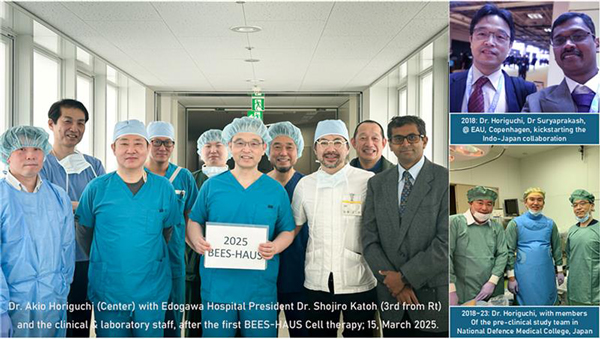
The first clinical BEES-HAUS procedure was accomplished in Edogawa Hospital, Japan in March 2025, which is the fruit of joint efforts of an inter-disciplinary team of scientists and physicians in India and Japan.
The BEES-HAUS* is a novel autologous buccal mucosal cell-based therapy for short segment stricture of male urethra which is otherwise tackled with either urethrotomy or dilatation subject to the status of the condition.
As buccal mucosal tissue based urethroplasty has been in practice, BEES-HAUS methodology of employing in vitro expanded autologous buccal mucosal epithelial cells transplanted after encapsulation in a nano-polymer scaffold for enhancing the healing with mucosal coverage of the otherwise stricture affected and/or fibrotic lumen is the brain child of the team headed by Dr Suryaprakash Vaddi (Consultant & HOD Urology, Narayana medical college, Nellore at the time of the pilot study) jointly with the team of Indo-Japan experts in tissue engineering and nanotechnology of NCRM, India & GN Corporation, Japan. The research on in vitro culture of human buccal mucosal tissue derived cells was initiated by Dr. Srinivas K Rao, an eminent Corneal Surgeon and chief consultant ophthalmologist of Darshan Eye Care, Chennai India to address ocular surface diseases especially bilateral corneal epithelial disease. Prior to this, unilateral corneal epithelial disease management using limbal tissue taken from the other normal eye cultivated without an human amniotic membrane, Limbal epithelium Expanded and Encapsulated in scaffold – Hybrid Approach to Regenerate Cornea (LEES-HARC) had completed pre-clinical evaluation with successful outcome. Such buccal tissue derived cells based sheet though had been earlier reported by Nishida et al, our aim was to avoid biological contamination during in vitro culture of tissues. When the basic research of in vitro culture of human buccal tissue was underway, the brilliant idea of Dr Suryaprakash to try applying buccal cells through an endoscope into the urethra instead of tissue transplant through an invasive surgical procedure to address male urethral stricture, lead to this breakthrough solution, which is less invasive, less painful and requires only shorter duration of hospital stay.
BEES HAUS procedure not only needs a smaller quantity of tissue (4 - 5 mm punch biopsy) from the buccal cavity against a larger (50 - 60 mm patch) strip of mucosal tissue for surgical procedure avoiding oral morbidity, but also preserves the integrity of the urethral lumen, during cell transplant without surgical manipulation. Instead of a surgery under general anesthesia, the endoscopic procedure lessens hospital stay duration and therefore cost. Having been proven to be successful in even previously recurring stricture following surgical reconstruction and repeated urethrotomy and dilatations, this procedure when applied as the first option in short segment strictures is likely to yield longer stricture recurrence free quality of life to patients. A patent has been granted in Japan and pending in EU and USA. After subsequent validation and standardization in animal models proving the engraftment by immunohistochemical markers as well, Dr. Horiguchi and team have started the clinical application in Japan. Further improvised and simplified procedure "BHES-HAUS" is underway.
*BEES-HAUS stands for Buccal epithelium Expanded and Encapsulated in Scaffold‐Hybrid Approach to Urethral Stricture (BEES‐HAUS) procedure.

In vitro expansion and transplantation of the cells have been made possible through an inter-disciplinary interaction with polymer scientists in Japan who could develop a safer variant of the scaffold free from endotoxin, the “FESTIGEL” (Free-from-Endotoxin-excess-Scaffold of Thermoresponsive Intelli-GEL), exclusively for translational applications.
Further Updates
Considering the implications of evolving inflammation related Biomarkers in recurrence of urethral stricture we have started compiling relevant data from institutes as well as from public in the portal Hausscore.com
PUBLICATIONS ON BEES-HAUS
12. Suryaprakash V, Senthilkumar R, Horiguchi A, Reddy DSK, Rajmohan M, Karthick R, Preethy S, Abraham SJK. Comparative analysis of maximal urinary flow rate (Qmax) across different treatment modalities for male urethral stricture and its role as a predictor of long-term therapeutic outcome. Bladder. 2026:e21200086. doi:10.14440/bladder.0374.
11. Horiguchi A, Kushibiki T, Mayumi Y, Shinchi M, Ojima K, Hirano Y, Katoh S, Iwasaki M, Abraham SJK, et al. A hybrid combination of in vitro cultured buccal mucosal cells using two different methodologies, complementing each other in successfully repairing a stricture-inflicted human male urethral epithelium. Front Urol. 2025;5:1720445. doi:10.3389/fruro.2025.1720445.
10. Horiguchi A, Vaddi S, Rajappa S, Preethy S, Abraham SJK. BEES-HAUS preventing urethral stricture recurrence by restoring the integrity of urothelium and its further simplified version, the BHES-HAUS. Front Bioeng Biotechnol. 2025 Nov 27;13. doi: 10.3389/fbioe.2025.1687741.
9. Vaddi SP, Reddy VB, Abraham S. Buccal epithelium Expanded and Encapsulated in Scaffold‐Hybrid Approach to Urethral Stricture (BEES‐HAUS) procedure: A novel cell therapy‐based pilot study . Int J Urol. 2018 Nov 22.
8. Horiguchi A. Editorial Comment from Dr Horiguchi to Buccal epithelium Expanded and Encapsulated in Scaffold-Hybrid Approach to Urethral Stricture (BEES-HAUS) procedure: A novel cell therapy-based pilot study. Int J Urol. 2018 Nov 28. doi: 10.1111/iju.13874.
7. Takao T. Editorial Comment from Dr Takao to Buccal epithelium Expanded and Encapsulated in Scaffold-Hybrid Approach to Urethral Stricture (BEES-HAUS) procedure: A novel cell therapy-based pilot study. Int J Urol. 2018 Dec 16. doi: 10.1111/iju.13884.
6. Katoh S, Rao KS, Suryaprakash V, Horiguchi A, Kushibiki T, Ojima K, Iwasaki M, Takeda M, Senthilkumar R, Rajmohan M, Karthick R, Preethy S, Abraham S. A 3D polymer scaffold platform for enhanced in vitro culture of Human & Rabbit buccal epithelial cells for cell therapies. Tokai J Exp Clin Med 2021; 46(1):1-6
5. Horiguchi A, Ojima K, Shinchi M, Kushibiki T, Mayumi Y, Miyai K, Katoh S, Takeda M, Iwasaki M, Suryaprakash V, Balamurugan M, Rajmohan M, Preethy S, Abraham SJK. Successful engraftment of epithelial cells derived from autologous rabbit buccal mucosal tissue, encapsulated in a polymer scaffold in a rabbit model of a urethral stricture, transplanted using the transurethral approach.. Regen. Ther. 2021; 18:127-132. doi: 10.1016/j.reth.2021.05.004
4. Horiguchi A, Ojima K, Shinchi M, Kushibiki T, Mayumi Y, Kushibiki T, Katoh S, Takeda M, Iwasaki M, Yoshioka H, Suryaprakash V, Balamurugan M, Senthilkumar R, Abraham SJK. In Vitro Culture Expansion and Characterization of Buccal Mucosal Epithelial Cells for Tissue Engineering Applications in Urethral Stricture After Transportation Using a Thermoreversible Gelation Biopreservation and Biobanking 2021. doi: 10.1089/bio.2021.0079
3. Senthilkumar R, Yoshioka H, Katoh S, Iwasaki M, VSurya Prakash V, Balamurugan M, Dedeepiya VD, Preethy S, Abraham. Engraftment and proliferation of thermoreversible-gelation-polymer-encapsulated human corneal limbal-stem-cells on ocular surface of a cadaver cornea. Current Eye Research. doi: 10.1080/02713683.2023.2180039.
2. Horiguchi A, Shinchi M, Ojima K, Hirano Y, Kushibiki T, Mayumi Y, Miyai K, Miura I, Iwasaki M, Suryaprakash V, Senthilkumar R, Preethy S, Katoh S, Abraham SJK. Engraftment of Transplanted Buccal Epithelial Cells onto the Urethrotomy Site, Proven Immunohistochemically in Rabbit Model; a Feat to Prevent Urethral Stricture Recurrence. Stem Cell Rev Rep. 2022 Oct 28; doi: 10.1007/s12015-022-10466-1.
1. Vaddi S, Horiguchi A, Senthilkumar R, Preethy S, Abraham SJK. Comment on “Comparative efficacy of autologous adult live cultured buccal epithelial cells (AALBEC) and minced buccal mucosal graft endourethral urethroplasty (MBGEU) in male urethral stricture” by Singh K et al. Int Urol Nephrol 2025. doi:10.1007/s11255-025-04642-8
LIST OF PRESENTATIONS
7. 17 May 2026: Vaddi S, Senthilkumar R, Reddy SK, Kumar CA, Shilpa P, Horiguchi A, Preethy S, Abraham SJK. Buccal Epithelium Hashed and Encapsulated in Scaffold–Hybrid Approach to Urethral Stricture (BHES-HAUS) - Preliminary Outcomes of Clinical Trial. Interactive Presentation. American Urological Association (AUA) Annual Meeting 2026; Washington, DC, USA. Abstract published in Journal of Urology [Internet]. 2026 May 1 [cited 2026 Apr 27];215(5S):e1312
6. 26, March 2025: Horiguchi et al., Endoscopic Tissue Engineering in Urethral Stricture: Cultured Oral Mucosa Trans plantation with the BEES-HAUS Method (Lecture) Akio Horiguchi . IMORU, Hamburg, Germany.
5. 26~27, July 2024: Horiguchi et al., Research and clinical application scenario of the BEES-HAUS method in managing male urethral stricture. 35th Annual Conference of the Association of Southern Urologists in Madurai, India. ( 26th July from 11.40 AM to 12.00 PM)
4. 13~16, May 2022: Akio Horiguchi, Toshihiro Kushibiki, Kenichiro Ojima, Masayuki Shinchi, Yusuke Hirano, Yoshine Mayumi, Keiichi Ito, Kosuke Miyai, Saitama, Japan, Ichiro Miura, Hokkaido, Japan, Masayuki Takeda, Masaru Iwasaki, Yamanashi, Japan, Shojiro Kato, Senthilkumar Rajappa, Tokyo, Japan, Samuel JK Abraham, Yamanashi, Japan., Successful Transurethral Engraftment of Buccal Mucosal Cells Expanded In Vitro, Transplanted in a Polymer Scaffold Carrier in a Rabbit Urethral Stricture Model, and Proven with Immunohistochemical Biomarkers; American Urology Association Annual meeting- AUA 2022, New Orleans, USA.
3. 06, March 2018: Abraham S. A novel solution for urethral repair - the BEES HAUS procedure. Oral Presentation, Regenerative Medicne Cross Road #7, Tokyo, Japan.
2. 5-8, February 2015: Surya Prakash V, Abraham S, Vijaya Bhaskar R, Vijay Kumar Reddy V, Venu M.Regenerative Medicine in Urology. SS BAPAT Best Paper Prize for INNOVATIONS & NEW TECHNOLOGY.USICON 2015. Mega Sports Complex Khelgaon, Ranchi, India
1. 12-16, October 2014: Surya Prakash V, Abraham S, Reddy VB, Chandra Mohan G, Vijay Kumar Reddy V. A novel cell based therapy using Buccal epithelium Expanded and Encapsulated in Scaffold(BEES-HAUS) - Hybrid Approach to treat Urethral Stricture. 34th Congress of the Société Internationale d'Urologie (SIU), Glasgow, UK