|
(Image Source: Horiguchi A, et al. Front Bioeng Biotechnol. 2025 Nov 27;13. doi: 10.3389/fbioe.2025.1687741)
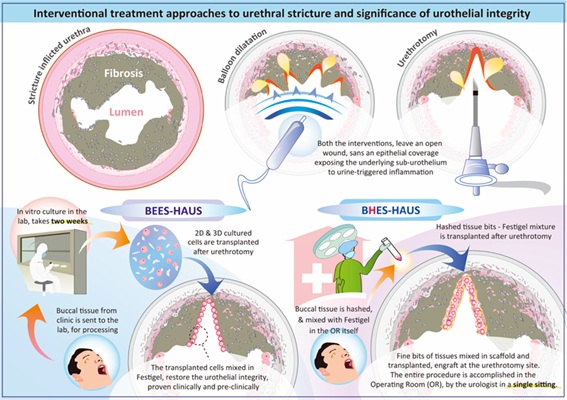
The BEES-HAUS is an endoscopic procedure for treating urethral stricture in which buccal cells are cultured for 14 days and then transplanted autologous to the patient using a scaffold called Festigel. A simplified approach is BHES-HAUS which doesn’t require 14 days of cell culture but rather the buccal epithelial tissue is taken from the patient, hashed and transplanted using Festigel in same sitting to the patient with urethral stricture. Clinical trials underway and preliminary data has been accepted for an interactive presentation in. AUA 2026, Washington DC, USA
Chennai, 17th January, 2026: In the first of its kind cell therapy approach combining two-dimensional (2D) cultured cells and another group of cells cultured in three-dimensional (3D) Festigel scaffold, both from buccal tissue, which has yielded clinical efficacy, pre-clinical proof of evidence of cell engraftment and mechanistic insights into healing effects by both transplanted cells and paracrine effects, has been published in the Frontiers in Urology Journal.
In this collaborative work among physicians, scientists and urologists from India and Japan since 2012, the following have been discovered,
i. Paracrine effect of insulin like growth factor (IGF)-1 secreted by fibroblasts have been proven in clinical specimens cultured in 2D by Horiguchi et al.
ii. Cell transplantation per se of the buccal epithelial cells on the urothelium have been proven to yield clinical efficacy of relief of urethral stricture along with prevention of its recurrence, as reported by Suryaprakash et al.
In the background of majority of cell based approaches in the domain of regenerative medicine yielding clinical efficacy majorly attributed to the paracrine effects of the transplanted cells, the combination of the 2D and 3D cells yielding successful outcome of not only relief of urethral stricture and also preventing further recurrence of the disease, according to Urologists could be the first of its kind report in the literature, which has unraveled the mechanism of this hybrid-approach in working together to yield healing of the stricture inflicted urethra. This feat has a great potential in developing similar cell therapy approaches for restoring or repairing epithelial damage of other organs as well.
This effort initiated by Dr. Suryaprakash & his team of Urologists along with Nichi-In Centre for Regenerative Medicine (NCRM), India in 2012 following a successful clinical study and immunohistochemical, morphological proof of engraftment in preclinical studies by Dr. Horiguchi from National Defense Medical College Hospital (NDMC), Japan along with proof of cell secreted factors contributing to healing of urethral stricture both from human buccal tissue samples and samples from animal models, have been approved for a clinical application of this Buccal epithelium Expanded and Encapsulated in Scaffold‐Hybrid Approach to Urethral Stricture (BEES‐HAUS) procedure in Japan under the act on Safety of Regenerative Medicine (RM) in Japan.
GN corporation, Japan which spearheaded this teamwork through NCRM has started a collaboration with SoulSynergy Lab Mauritius, which has been approved by the Government of Mauritius to provide this treatment in Mauritius and also serve as a tech-transfer hub for Regenerative Medicine (RM) therapies from Japan to Indian ocean rim countries and the entire African Continent.
A further simplified version of the BEES-HAUS called BHES-HAUS (Buccal Epithelium Hashed and Encapsulated in Scaffold – Hybrid Approach to Urethral Stricture) which doesn’t require 14 days of lab culture but rather a single-sitting procedure in which the buccal tissue is taken from the patient, hashed and transplanted along with the Festigel Scaffold is undergoing clinical trial and the preliminary results of the clinical trial has been accepted for an interactive presentation at the American Urology Association (AUA) 2026 Annual Meeting in Washington, DC, USA.
Taking these studies further, efforts are underway to develop an AI based predictive tool called HAUS’Score to assess the risk of urethral stricture recurrence using inflammatory immunological ratios such as the Neutrophil to Lymphocyte (NLR) ratio and other systemic biomarkers.
|
 Search
